Guide·
Winter Collection 2026: A Pakistani Fabric Buying Guide
Khaddar, linen, karandi or wool-blend — what Pakistani winter fabrics actually are, how to judge weight when you are buying online, and when unstitched beats ready-to-wear.
Winter drops start landing in Pakistan from late September, and by October the word winter collection 2026 is on every brand's homepage. The word does a lot of work and explains very little. A "winter" suit can mean a heavy wool-blend you could wear in Murree, or it can mean the same lawn-weight cotton you wore in August with a darker print on it.
This guide is about telling those apart — what the fabrics actually are, how to judge weight when you are buying online and cannot touch anything, and when unstitched beats ready-to-wear. It is deliberately not a list of things to buy from us. We make a short list of pieces and we will say plainly, further down, where they fit and where they do not.
First: which winter are you buying for?
Pakistan does not have one winter, and this is the single biggest reason people end up with a suit they never wear.
- Karachi and the coast. A handful of genuinely cool weeks, mostly in the mornings and after dark. Mid-weight cotton with a shawl covers almost the whole season. A wool-blend suit will be too warm by 11am.
- Lahore, Faisalabad, Multan. A real winter with cold mornings and fog. This is khaddar and karandi country — enough weight to hold warmth, not so much that you cook indoors.
- Islamabad, Peshawar and further north. Cold enough for wool-blends, and cold enough that layering matters more than the suit itself.
Buy for the city you actually live in, not for the photoshoot.
The winter fabrics, plainly
Khaddar
A cotton woven on a heavier, looser setting — the weave is visible and slightly irregular, which is the point. It is the default Pakistani winter fabric because it sits in the middle: warm enough for a Lahore December, breathable enough that you are not miserable in a heated room. It takes embroidery well and it softens with washing rather than falling apart.
Winter linen
Slubby, a bit structured, holds its shape. It photographs beautifully and drapes more crisply than khaddar. Weight varies enormously between mills, so "linen" on a label tells you very little on its own — a light winter linen and a heavy one are different garments.
Karandi
A blended fabric with a speckled, flecked look, usually cotton with wool or a synthetic blended in. Warmer than khaddar, and the fleck hides creasing, which is why it survives a working day better than most winter fabrics.
Wool-blend and wool peach
The warmest of the common options, and the softest to the hand. Best for the north. In Karachi it is an occasion fabric rather than an everyday one.
Velvet
Heavy, formal, and firmly occasion-wear. Beautiful for a December wedding, impractical for anything else, and difficult to care for. Buy it knowing that.
Cotton with a shawl
The unglamorous answer, and the right one for a lot of people. A good mid-weight cotton suit plus a proper shawl is warmer, more flexible and cheaper than a dedicated winter suit you wear six times.
How to judge weight when you are buying online
You cannot feel fabric through a screen, so judge it indirectly:
- Ask for the weight in GSM. Grams per square metre is the only number that actually means something. Roughly: under 120 GSM is summer-weight, 150–200 is a true mid-weight winter fabric, above 200 is heavy. Many Pakistani sellers will not have this to hand — that in itself is worth knowing.
- Ask for a photo held up to the light. If you can read the outline of a hand through it, it is not a winter fabric, whatever the collection is called.
- Look at how it falls in the product photos. Heavier fabric hangs in fewer, deeper folds. Light fabric clings and ripples. Flat-lay photos hide this; photos on a person do not.
- Ask what the dupatta is. Brands often pair a warm shirt with a thin chiffon dupatta, which is fine — but you should know it before it arrives, not after.
- Ask a human. If a seller cannot describe their own fabric beyond the marketing name, that is an answer too.
Unstitched or ready-to-wear?
Winter is the season where this choice matters most, because winter fabric is less forgiving to cut and a bad fit shows through more layers.
Unstitched gives you control — your own tailor, your own measurements, your own sleeve length. The costs people forget are the tailoring charge on top of the fabric, and two to three weeks of waiting at exactly the time of year every tailor in the city is buried. If you have a tailor who already knows your measurements, unstitched is usually the better buy.
Ready-to-wear costs you fit precision and gains you certainty and speed. It only works if the brand publishes a real size chart with actual measurements — bust, waist, hip, length in inches — rather than just S/M/L. If the measurements are not published, you are guessing, and a winter suit is an expensive thing to guess at.
Where Stitch Pearl fits — and where it does not
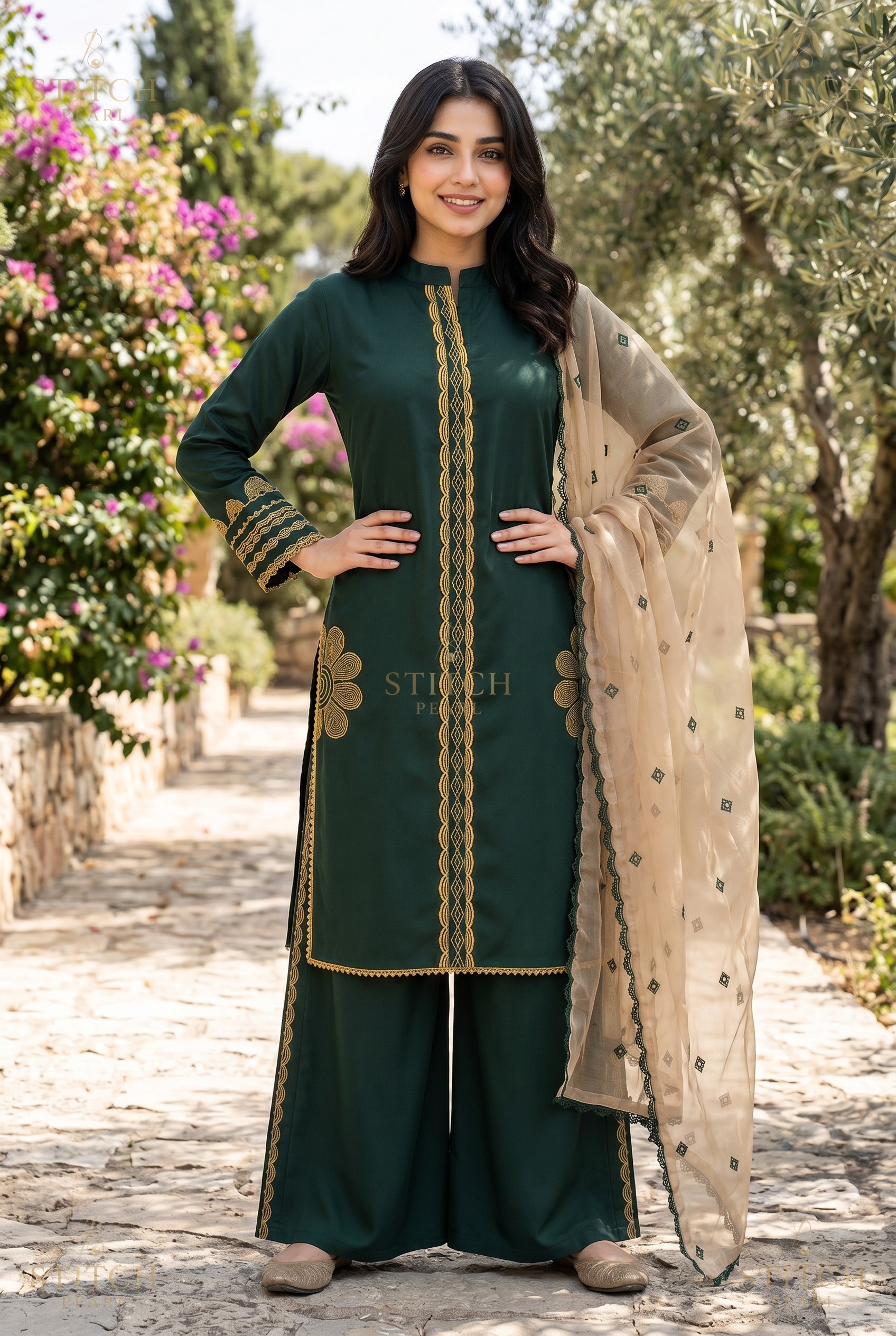
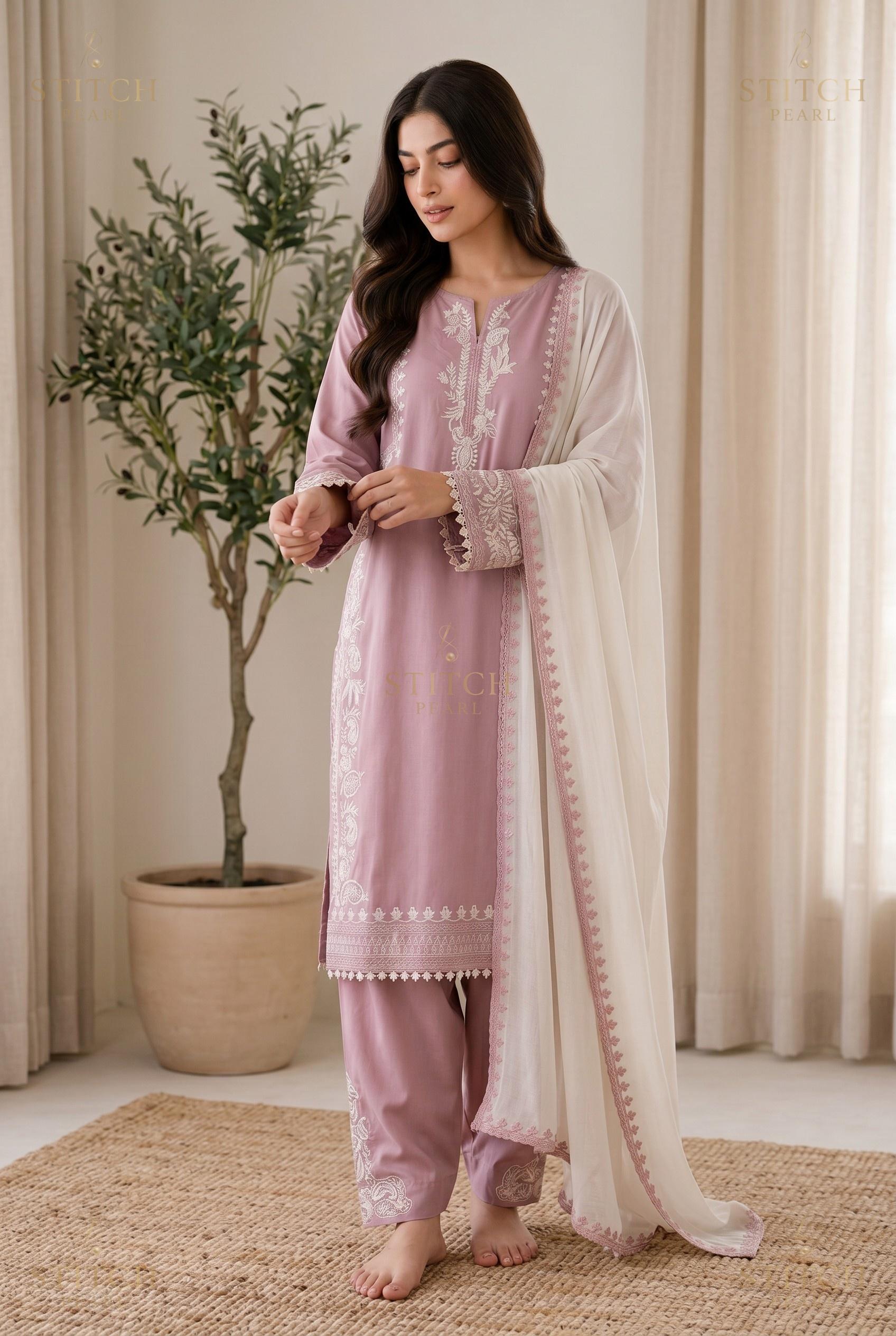
We make embroidered 3-piece cotton suits, hand-finished in our Karachi studio, in a short list of designs. That is the whole catalogue. We do not make khaddar, we do not make wool-blends, and we do not have a separate winter line.
What that means for you, honestly:
- If you are in Karachi, a mid-weight cotton suit with a shawl is what most of the season actually needs, and that is what we make.
- If you are buying for an Islamabad January, buy khaddar or a wool-blend — from whoever makes it well. We would rather tell you that than sell you cotton for a cold city.
- Our sizes are S, M and L with published measurements in inches on the size chart. XL is cut to your own measurements rather than held in stock — message us and we will confirm before you order.
- Our suits come stitched or unstitched on selected designs, so you can hand the fabric to your own tailor if you would rather.
Everything we sell is listed with what it is actually made of — which fabric the shirt is, which the shalwar, which the dupatta — on the collection page.
A short checklist before you order
- Does the weight match your city, not the campaign photos?
- Do you know what the dupatta fabric is?
- Are there published measurements in inches, or only S/M/L?
- If unstitched — have you added the tailoring cost and the waiting time?
- Do you know the exchange terms before you pay, not after?
Ours are seven days from delivery on unworn pieces, set out in full on the exchanges page, and delivery inside Pakistan is a flat charge explained on the shipping page.
Buy the fabric, not the season's name on it. A suit that suits your weather gets worn; a suit that suits the label sits in the cupboard.